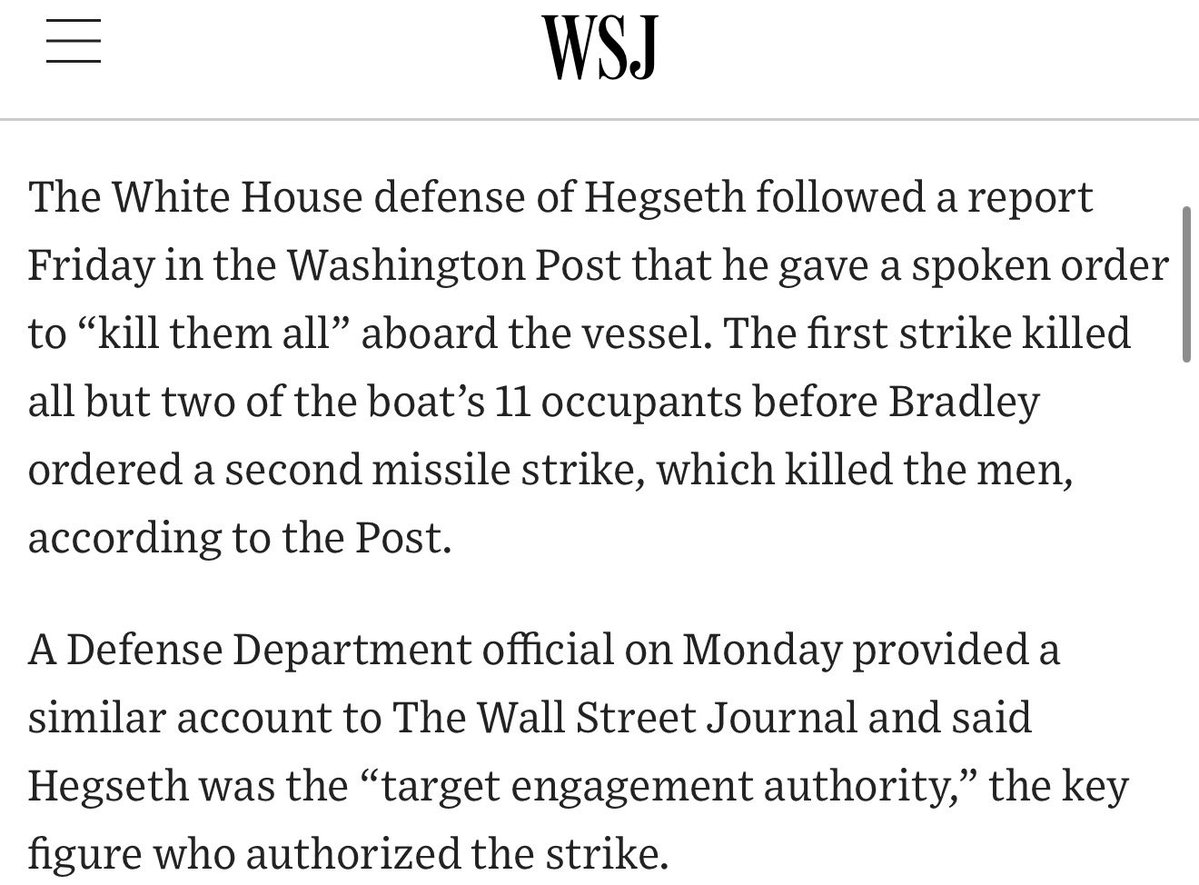
There was the usual cabinet meeting today, where the occasion was used as a press opportunity. In this instance, ‘narco-terrorist’ remains a misnomer, the 2 September mission’s Target Engagement Authority (TEA) was the SecDef, and both Trump and Hegseth made the illegal killing Admiral Bradley’s responsibility. Hegseth cited the ‘fog of war’ as something, something, reasons.
There was no “fog of war” mainly because there is no war in the Caribbean, but even more important there was no battle ‘fog’ in this instance: there were survivors, and they were deliberately killed, not due to communication problems or that they represented a continuing threat. And there are actual rules that attempt to set the US military apart from others. Such as not killing survivors being important to maintaining military discipline.
The first known attempt to explicitly define the "fog of war" in a military text was made in 1896 in a book titled The Fog of War by Sir Lonsdale Augustus Hale, where it is described as "the state of ignorance in which commanders frequently find themselves as regards the real strength and position, not only of their foes, but also of their friends."[6]
----------
The fog of war is a reality in all military conflict. Precision and certainty are unattainable goals, but modern military doctrine suggests a trade-off of precision and certainty for speed and agility. Militaries employ command and control (C2) systems and doctrine to partially alleviate the fog of war.
The term also applies to the experience of individual soldiers in battle: often cited is the pure confusion of direction, location, and perspective on a battlefield. Officers and soldiers become separated, orders become confused and subject to revision with poor communication. Sounds and vision are limited from the perspective of the individual and may not be easily resolved, resulting in a continuing uncertainty, a perceptual "fog".
The fog of war has been decreasing as intelligence, surveillance and reconnaissance technology is improving. In 2016, Chief of Staff of the United States Army Gen. Mark A. Milley stated that "On the future battlefield, if you stay in one place longer than two or three hours, you will be dead... With enemy drones and sensors constantly on the hunt for targets, there won't even be time for four hours' unbroken sleep."[7]
en.wikipedia.org/...
 The apparent typo comes just days after the Department of Labor came under fire after publishing an image that critics labeled as a “Nazi dog whistle.” That image featured the Lincoln Memorial statue with 11 stars dotted around the statue's head, which some believed referenced the 11 states of the Confederacy, and text written with Fraktur font, which was commonly used in the early Nazi period in Germany until 1941. www.rawstory.com/...