Welcome to the Street Prophets Coffee Hour cleverly hidden at the intersection of religion, art, science, food, and politics. This is an open thread where we can share our thoughts and comments about the day. Today we are going to start with a castle in Scotland.


Urquhart Castle was built upon the site of an early medieval fortification overlooking Loch Ness. There is some speculation that the early medieval fortification was the fortress of the king of the northern Picts, Bridei son of Maelchon which was visited by St. Columba sometime between 562 and 586. The present castle was originally established in the thirteenth century, probably between 1230 and 1275.
In 1296, Urquhart Castle was captured by King Edward I of English in an invasion which marked the beginning of the Wars of Scottish Independence. Edward I appointed Sir William fitz Warin as constable to hold the castle for the English. By 1298, the Scots once again controlled the castle.
In 1303, the English once again gained control of Urquhart Castle. Sometime after 1307, it was declared a royal castle and was held for the Crown by a series of constables. The only king who ever stayed in the castle was King David II who spent the summer of 1342 hunting from the castle.
In 1395, the Scots under Domhnall of Islay seized control of Urquhart Castle and held it for more than 15 years. Sometime after the Battle of Harlaw in 1411, the Crown regained the castle.
In 1476, Urquhart was turned over to the Earl of Huntly who brought in Sir Duncan Grant to restore order in the area around the castle. In 1509, King James IV granted Urquhart Castle to John Grant on the condition that he repair and rebuild the castle. The Grants maintained ownership of the castle until 1912.
In 1545, the MacDonalds attacked Urquhart and stripped the castle of everything of value, including locks, doors, beds, chairs, tables, pots, feather beds, blankets, boats, and livestock.


The 1545 MacDonald raiding party was targeting the territory of the Laird of Grant, the owner of the Urquhart Castle, as retaliation for fighting against the MacDonalds at the Battle of the Swampy Meadow. This was final MacDonald attack on the castle. According to a display at the castle:
“The MacDonald Lords of the Isles presided over a Gaelic cultural renaissance in the Western Highlands and Islands. Their rule, almost independent of the Crown, provided the stability needed for Gaelic art, music and poetry to reach new heights of sophistication.”
In 1689, 300 Highlanders led by Captain James Grant held the Urquhart Castle against a force of 500 Jacobites. The Highlanders were holding the castle for Queen Mary II and her husband King William II, while the Jacobite were seeking to return James VII to the throne. While the Highlanders successfully held the castle, the government decided that it was not worth defending. In 1692 the castle was blown up so that it could not fall into Jacobite hands.


The Great Hall and the Great Kitchen


The Water Gate

The Water Gate linked Urquhart Castle with the rest of the world. In the medieval world, waterways, such as lochs, served as highways. People and goods during this era traveled by boat.
Doocot
In the 1500s, the Doocot—a beehive-shaped home for pigeons—provided fresh meat and eggs, particularly during the winter months.
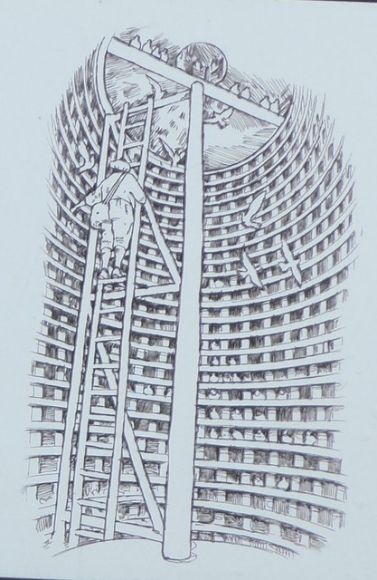


 Shown above are the three remaining stone pigeon boxes in the Doocot.
Re-enactors


Urquhart’s Past
According to a display at the castle:
“Urquhart Castle is a jigsaw puzzle with most of the pieces missing. Walls have been demolished and new ones raised many times during the last 1,500 years. Timber buildings have rotted away entirely.”
 Shown above is the small hilltop fort which occupied the site in the 500s.
 Shown above: in the 1200s, the small hilltop fort was replaced by a castle with a rectangular keep.
 Shown above: by the 1300s, the castle had evolved into a traditional keep-and-bailey castle with the keep on level ground rather than on the hilltop.
 Shown above: by the 1400s, the keep is still relatively small and there is a large great hall.
 Shown above: by the 1500s, the upper bailey was no longer in use. Grant tower now rises above the castle walls.
Open Thread